
PSOU Syllabus 2026: Subject-Wise Course Structure
Jagat Guru Nanak Dev Punjab State Open University (PSOU) provides subject-wise course structures for its Postgraduate, Undergraduate, Diploma, and Certificate programmes. Syllabi for the Bachelor of Arts (BA) for sessions 2024-25, 2025-26, 2026-27, and specific Diploma courses like Artificial Intelligence and Consumer Law and Practice, include details on subjects, marks, credits, and examination patterns.
Key facts
| BA Syllabus Validity | Sessions 2024-25, 2025-26, 2026-27 |
|---|---|
| BA/General Course External Marks | 70 |
| BA/General Course Internal Marks | 30 |
| BA/General Course Pass Percentage | 40% |
| Diploma in Consumer Law & Practice Exam Type | 70 Multiple Choice Questions (MCQs) |
| Diploma/Certificate in AI Pass Percentage | 35% |
Accessing PSOU Syllabi
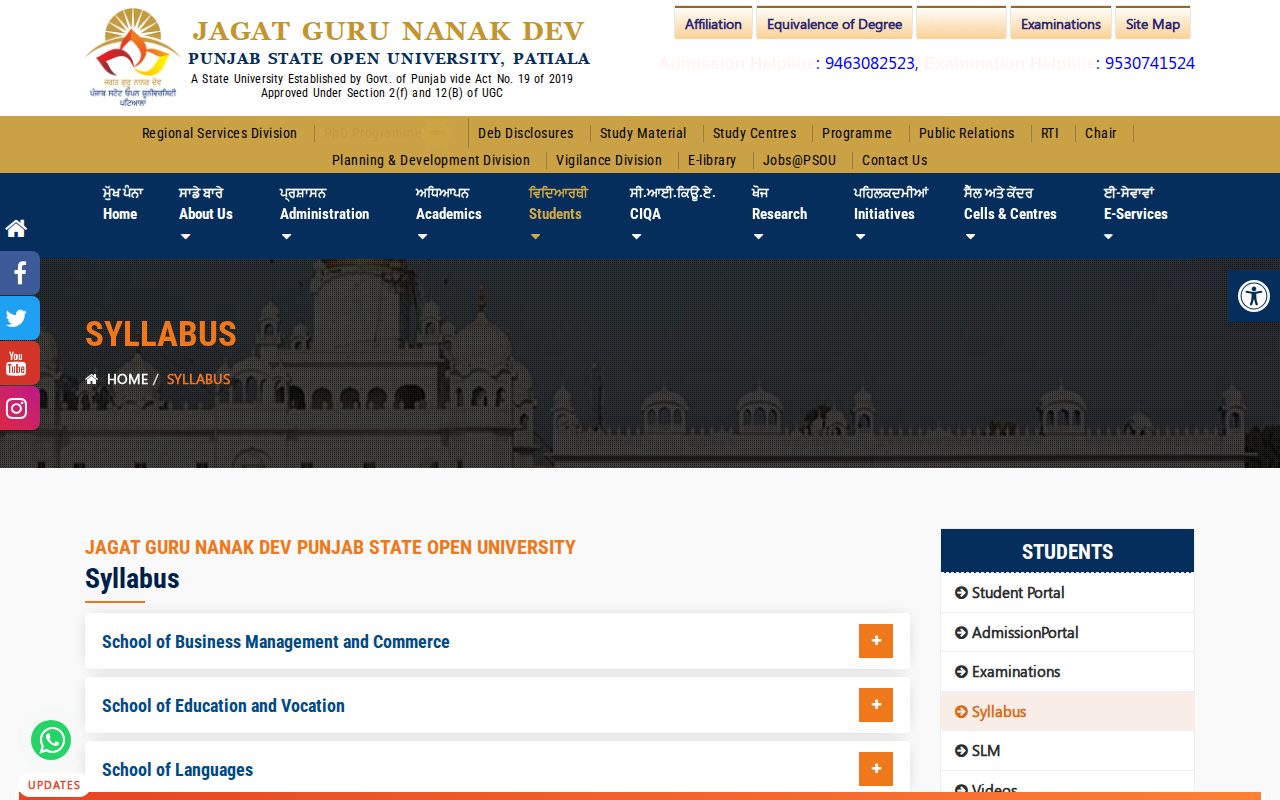
The Jagat Guru Nanak Dev Punjab State Open University publishes subject-wise syllabi for its various programmes. Students can find detailed course structures for Postgraduate, Undergraduate, Diploma, and Certificate programmes on the university’s official syllabus page.
For specific programmes, detailed syllabi are available as PDF documents, which include information on course objectives, units, suggested readings, and examination patterns.
Bachelor of Arts (BA) Syllabus (Sessions 2024-25, 2025-26, 2026-27)
The Bachelor of Arts (BA) programme syllabus is applicable for the academic sessions 2024-25, 2025-26, and 2026-27. Each course carries a maximum of 100 marks, split into 70 external marks and 30 internal marks. The pass percentage for each course is 40%.
- Ability Enhancement Compulsory Course (AE-1) Semester I: (AE1B31107T) Effective Communication in English (4 Credits)
- Sikh Heritage and Ethos (Credits: Not specified in source for BA, but listed as a course)
- Punjabi Compulsory (Credits: Not specified in source for BA, but listed as a course)
BA Semester I Core Courses
| Course Code | Course Name | Credits |
|---|---|---|
| BAB31101T | Micro Economics | 6 |
| BAB31102T | An Introduction to English Literature | 6 |
| BAB31103T | History of India: Indus Civilization to c. 1200 CE | 6 |
| BAB31104T | Principles of Political Science | 6 |
| BAB31105T | Introduction to Sociology | 6 |
BA Semester II Core Courses (Sessions 2024-25, 2025-26, 2026-27)
For the second semester of the Bachelor of Arts programme, students will study Macro Economics, which covers theories related to national economy, income, consumption, investment, employment, money, interest, inflation, and economic policies.
BA Semester II Core Course
| Course Code | Course Name | Credits |
|---|---|---|
| BAB31201T | Macro Economics | 6 |
B.Com (Hons.) (Accounting and Taxation) Syllabus
The B.Com (Hons.) in Accounting and Taxation is a 4-year undergraduate degree programme. The syllabus below outlines the subjects for the first eight semesters.
B.Com (Hons.) (Accounting and Taxation) Semester-Wise Subjects
| Semester | Subjects |
|---|---|
| 1 | Effective Communication in English, Financial Accounting (Major), Business Organization and Management, Punjabi Compulsory, Sikh Heritage and Ethos |
| 2 | Environmental Studies, Business Law (Major), Business Mathematics and Statistics, English Compulsory, Fundamentals in Digital Marketing, Human Rights and Duties |
| 3 | Company Law (Major), Corporate Accounting (Major), Enhancing Happiness at Workplace, Fundamentals in Computer, Drug Abuse: Problem, Prevention and Management |
| 4 | E-Financial Market and Services (Major), Marketing Management, Cost Accounting (Major), Business Economics (Major) |
| 5 | Auditing and Corporate Governance (Major), Human Resource Management, Digital Marketing Platforms OR E-Commerce, E-Banking Operations and Services (Major) OR Fundamental of Insurance (Major) |
| 6 | Income Tax Law and Practice (Major), Digitalized Income Tax Accounting and Documentation (Major), Organization Theory and Behavior OR Business Environment, Entrepreneurship Development OR Management Information System |
| 7 | Management Accounting (Major), Goods & Service Tax Law and Practice (Major), Digitalized Goods and Service Tax Accounting and Documentation (Major), Business Etiquette, Macro Economics OR Rural Development |
| 8 | Financial Management (Major), Computerized Statistical Data Analysis, Research Methodology OR Indian Economy, Logistics Management OR Sales Management |
M.Com Syllabus
The M.Com is a 2-year postgraduate degree programme. The syllabus below outlines the subjects for the four semesters.
M.Com Semester-Wise Subjects
| Semester | Subjects |
|---|---|
| 1 | Organization Theory and Behaviour, Business Environment, Accounting For Managerial Decisions, Seminar-I |
| 2 | Computer Applications in Business, Marketing Management, Financial Management, Viva Voce |
| 3 | Management of Financial Services, Entrepreneurship Development, Research Methodology and Statistical Analysis, Seminar-III |
| 4 | Corporate Legal Framework, Managerial Economics, Principles and Functions of Management, Viva Voce |
Diploma in Consumer Law and Practice (Semester I) Syllabus
The Diploma in Consumer Law and Practice includes specific courses in Semester I with a unique examination pattern. Each course carries a maximum of 100 marks, with 70 external marks and 30 internal marks. A pass percentage of 40% is required.
- The Consumer Protection Act 2019: An Overview covers the need and nature of consumer laws, salient features of the 2019 Act, differences from the 1986 Act, key definitions (Consumer, Goods, Service, E-Commerce, Unfair Trade practice), and consumer protection legislations in India.
- Consumer Protection Act 2019: Legal Analysis introduces the Act, Consumer Protection Councils (Sections 3-9), Central Consumer Protection Authority (Sections 10-17), its powers and functions (Sections 18-27), District Consumer Disputes Redressal Commission, e-filing of complaints, and ‘Jago Grahak Jago’ initiatives.
Diploma in Consumer Law and Practice Semester I Subjects
| Course Code | Course Name | Credits |
|---|---|---|
| DCLP-2 | The Consumer Protection Act 2019: An Overview | 6 |
| DCLP-3 | Consumer Protection Act 2019: Legal Analysis | 6 |
Diploma/Certificate in Artificial Intelligence Syllabus
The Diploma and Certificate courses in Artificial Intelligence have a common set of subjects. The Certificate course covers the first three subjects, while the Diploma course covers all six. Each theory paper has 70 external marks and 30 internal marks, with a pass percentage of 35%. The duration of each paper is three hours.
Artificial Intelligence Course Subjects
| Course Code | Course Name | Credits |
|---|---|---|
| GC-AI-01T | Statistical Foundation | 4 |
| GC-AI-01P | Statistical Foundation Lab | 2 |
| GC-AI-02T | Core Python Programming | 4 |
| GC-AI-02P | Core Python Programming Lab | 2 |
| GC-AI-03T | Introduction to Logic | 4 |
| GC-AI-03P | Introduction to Logic Lab | 2 |
| GC-AI-04T | Introduction to Data Visualization | 4 |
| GC-AI-04P | Introduction to Data Visualization | 2 |
| GC-AI-05T | AI using Python | 4 |
| GC-AI-05P | AI using Python | 2 |
| GC-AI-06P | Minor project | 4 |
Other Diploma Programmes Syllabus Overview
PSOU offers various other Diploma programmes with semester-wise subject breakdowns. Here is an overview of some of them:
Selected Diploma Programmes Semester-Wise Subjects
| Programme | Semester 1 | Semester 2 |
|---|---|---|
| Retail and Sales Management | Retail Management, Sales Management, Digital Marketing, Seminar on Recent Issues in Retail & Sales Management | Consumer Behaviour, Service Marketing, Logistics and Supply Chain Management, Seminar on Contemporary Trends in Marketing, Services and Supply Chain |
| Accounting and Taxation | Basics of Financial Accounting and Accounting Software, Basics of Income Taxation, Basics of Goods and Service Tax, Seminar on Contemporary Issues in Accounting | Digitalized Accounting, Digitalized Goods and Service Tax, Income Tax and E-Filing, Seminar on Contemporary Issues in Taxation |
| Organic Farming | Organic Farming – I, Organic Farming – II, Practical and Project-I | Organic Farming – III, Organic Farming – IV, Practical and Project-II |
| Nanny Care | Pre-natal and Post-natal care, Child Development, Practical | Early Childhood Care and Education, Nutrition and Meal Management, Project Work/Field Visit/ On the Job Training |
| Library and Information Science | Basics of Library and Information Science, Library Substance Organisation, Library Automation, Knowledge Organisation: Classification (Project I) | Library Administration and Management, Information Sources and Services, Fundamentals of ICT in Libraries, Knowledge Organisation: Cataloguing (Project II) |
| Horticulture | Horticulture I, Horticulture II, Practical and Project Work I | Horticulture III, Horticulture IV, Practical and Project Work II |
| Gender and Cultural Studies | Principles and History of Gender Studies, Sociology of Gender, Gender, Law, and Human Rights, Gender Sensitization, Project – I (Practical) | Gender, Economy, and Development, Media, Culture, and Gender Representation, Research Methodology in Gender Studies, Field Project – II (Specialized) |
| Food Processing and Preservation | Food Preservation I, Fundamentals of Nutrition, Practical and Project-I | Food Preservation II, Bakery and Confectionery, Practical and Project |
| Fashion Designing | Pattern Making & Draping, Fashion Illustration and Fashion Concepts, Fashion Illustration and Fashion Concepts Lab, Garment Construction & Surface Ornamentation | Fashion Illustration, Fundamentals of Textile, Fundamentals of Textile Lab, CAD in Fashion, Project |
| Care Giver | Environment, Health and Disability, Nutrition and Meal Management, Practical | Emergency, First Aid and Enabling caregivers, Health & Personal Hygienic Care, Project Work/Field Visit/On the Job Training |
Certificate Programmes Syllabus Overview
PSOU offers various Certificate programmes, typically of 6 months duration. Here is an overview of their Semester 1 subjects:
Selected Certificate Programmes Semester 1 Subjects
| Programme | Semester 1 Subjects |
|---|---|
| Stock Market and Trading Operations | Elements Of Financial Services And Market, Basics Of Security Analysis And Portfolio Management, Risk Management, Seminar on Recent Trends in Stock Market and Trading Operations |
| Rural Management | Rural Sector in India, Rural Development: Planning and Programmes, Rural Management, Seminar on Recent Trends in Rural Management |
| Finance for Non Finance | Basics of Financial Accounting and Financial Statement Analysis, Corporate Finance, Investment Management, Seminar on Financial Literacy: Building Your Money Foundation |
| Entrepreneurship Creativity and Innovation in Business | Entrepreneurship, Innovation and Creativity, Management of MSME, Project Planning, Seminar on Business Development Plan |
| Corporate Social Responsibility | Foundations of Corporate Social Responsibility, Sustainable Development and Responsible Business Practices, Innovative CSR Programme Design, Project Work |
| Computer Aided Accounting | Basics of Computerized Accounting, Applications of Tally in Accounting, Digitalized Final Accounting, Seminar on Contemporary Issues in Accounting |
| Business Etiquette and Professionalism | Business Etiquette, Soft Skills, Organizational Behaviour and Professionalism, Seminar on Digital Professionalism and Workplace Ethics |
| Banking and Financial Services | Banking: Financial & Non-Financial Payment System, Regulatory Requirements, Internship Component |
| Yoga | Foundation |
General Examination Pattern for Theory Papers
For most theory papers in BA and other programmes, the question paper structure is consistent. The duration of each paper is three hours.
- The question paper consists of three sections: A, B, and C.
- Sections A and B will have four questions each from their respective syllabus sections, carrying 10 marks each. Candidates must attempt two questions from each section.
- Section C will have fifteen short answer questions covering the entire syllabus, each carrying 3 marks. Candidates must attempt any ten questions from this section.
Examination Pattern for Diploma in Consumer Law and Practice
For the Diploma in Consumer Law and Practice, the examination pattern is based on Multiple Choice Questions (MCQs). The duration of each paper is two hours.
- The question paper will have 70 Multiple Choice Questions (MCQs) with four choices of answers, covering the entire syllabus.
- Each question carries 1 mark, and all questions are compulsory.
- There is no negative marking.
- Students are required to answer using OMR (Optical Mark Recognition) sheets.
- Questions are distributed equally from Section A and Section B of the syllabus (35 questions from each).
Important PSOU links
| What you can do | Official page |
|---|---|
| Find PSOU programme syllabi | www.psou.ac.in/beta/syllabus |
| View all PSOU programmes | www.psou.ac.in/beta/courses |
Official documents (PDF)
- The Consumer Protection Act 2019: An Overview PDF — Syllabus for The Consumer Protection Act 2019: An Overview
- Consumer Protection Act 2019: Legal Analysis PDF — Syllabus for Consumer Protection Act 2019: Legal Analysis
Frequently asked questions
Where can I find the PSOU syllabus?
You can find the PSOU syllabus on the university’s official syllabus page. This page lists various programmes and provides links to detailed subject-wise course structures and PDF documents for specific courses. Visit the PSOU Syllabus page to explore.
What is the pass percentage for BA courses at PSOU?
For Bachelor of Arts (BA) courses at PSOU, the pass percentage for each course is 40% of the total marks. This applies to both external and internal components.
What is the examination pattern for most PSOU theory papers?
Most PSOU theory papers are three hours long and consist of three sections: A, B, and C. Sections A and B have four 10-mark questions each (attempt two from each). Section C has fifteen 3-mark short answer questions (attempt any ten).
How are marks distributed for BA courses?
For BA courses, the maximum marks for each paper are 100, comprising 70 external marks and 30 internal marks.
Is there a specific syllabus for the BA programme for the 2026-27 session?
Yes, the Bachelor of Arts (BA) syllabus provided by PSOU is applicable for the academic sessions 2024-25, 2025-26, and 2026-27.
Where can I find PSOU study material?
PSOU has not published information on where to find study material on its site as of 02 October 2026. You may need to contact the university directly for this information.
Sources
Written from the official PSOU pages and documents below, as read on 2 October 2026.
- Syllabus | Jagat Guru Nanak Dev Punjab State Open University, Patiala psou.ac.in/…/syllabus
- Diploma%20Course%20in%20Artificial%20Intelligence.pdf psou.ac.in/…/Diploma%20Course%20in%20Artificial%20Int
- BA%20Syllabus.pdf psou.ac.in/…/BA%20Syllabus.pdf
- Syllabus (ਸਿਲੇਬਸ) www.psou.ac.in/…/syllabus
- The Consumer Protection Act 2019: An Overview psou.ac.in/…/202605131210291f14c6ddd9.pdf
- Consumer Protection Act 2019: Legal Analysis psou.ac.in/…/20260513121052ce27b8957b.pdf